LNG (Liquefied Natural Gas)
0 Definition
LNG (Liquefied Natural Gas) is a cryogenic liquid hydrocarbon mixture obtained by systematically purifying natural gas — primarily methane (CH₄) — and cooling it to approximately −162°C at standard atmospheric pressure (1 atm). The purification process encompasses the recovery of valuable components (e.g., helium), the removal of heavy hydrocarbons, and the elimination of impurities detrimental to downstream operations (sulfur compounds, nitrogen, water, etc.). Liquefaction reduces the volume of natural gas to approximately 1/600 of its gaseous equivalent, substantially improving storage and transportation efficiency.[1]
1 Physicochemical Properties
LNG is predominantly composed of methane (CH₄, typically >90%), with minor fractions of ethane (C₂H₆), nitrogen (N₂, approximately 0.5–1%), and trace quantities of higher alkanes (C₃H₈ through C₅H₁₂). It presents as a colorless, odorless, non-toxic, and non-corrosive liquid. Key physicochemical parameters are summarized below[1]:
| Property | Value |
|---|---|
| Appearance | Colorless, odorless, non-toxic, non-corrosive liquid |
| Liquid density | ~430–470 kg/m³ (composition-dependent; ~45% of water density) |
| Normal boiling point | ~−162°C (at 1 atm) |
| Autoignition temperature | ~650°C |
| Mass-based heating value | ~52 MMBtu/t (1 MMBtu ≈ 2.52×10⁸ cal) |
| Vapor density (ambient conditions) | ~1.5 kg/m³ |
| Flammability limits (vol%) | 5%–15% |
| Volumetric expansion ratio | ~1∶624 (liquid to gas) |
Compared with other forms of natural gas storage and transport, LNG offers the following key advantages:
Storage Efficiency: The high liquid-to-gas density ratio minimizes land use and capital requirements. An estimated 10 m³ of LNG storage is sufficient to meet the daily residential gas demand of approximately 10,000 households.
Intrinsic Safety: Upon vaporization, LNG-derived gas has a density roughly half that of air and dissipates rapidly upward upon release, significantly reducing the risk of explosive accumulation in low-lying areas.
Transportation Advantage: The volumetric expansion ratio of approximately 1∶624 enables highly efficient energy transport. On an equivalent energy basis, LNG far outperforms compressed natural gas in cargo density per unit volume.
Environmental Performance: As a purified fossil fuel, LNG burns more completely than coal or LPG. Under fully combusted conditions, CO₂ and NOx emissions are approximately 50% and 20% of those from coal combustion, respectively, with sulfur-related emissions reduced by a factor of ~800 relative to coal. In the transportation sector, substituting gasoline with LNG reduces HC, NOx, CO₂, and SOx tailpipe emissions by approximately 72%, 39%, 90%, and ~100%, respectively.
Energy Utilization Efficiency: In power generation, natural gas achieves an overall thermal efficiency of approximately 55%, substantially exceeding oil-fired (~35–40%) and coal-fired (~30–35%) alternatives. This advantage is especially pronounced in peaking power plants requiring rapid load response.
2 Applications
LNG is widely regarded as one of the cleanest commercially available fossil fuels, characterized by negligible sulfur content. In power generation, NOx and CO₂ emissions from gas-fired plants are approximately 20% and 50%, respectively, of those from equivalent coal-fired facilities, delivering significant co-benefits in air quality and carbon reduction.
The primary application of LNG is to enable long-distance marine and overland natural gas transport to markets where pipeline infrastructure is technically or economically impractical.[2] In terms of volumetric energy density, LNG outperforms CNG (compressed at 250 bar) by approximately 2.4 times, and achieves roughly 60% of the energy density of diesel fuel.[3] LNG supply chains rely on purpose-built cryogenic LNG carriers and insulated road tankers; upon arrival at the destination, LNG is regasified at receiving terminals and injected into pipeline networks or consumed directly.
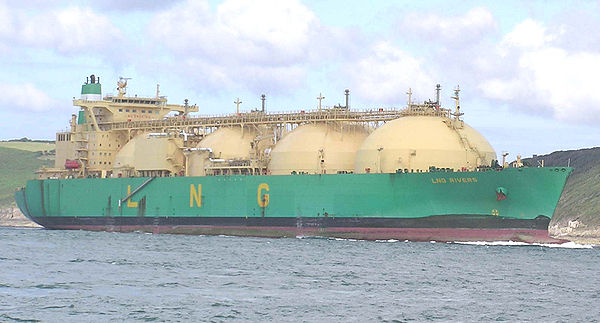
Principal end-use applications at onshore LNG terminals include:
- Grid peak shaving and emergency backup: Supplying urban gas networks during peak demand periods or supply disruptions.
- Primary city gas source: Serving as the main gas supply for large and medium-sized municipal pipeline networks.
- Distributed gasification supply: Providing gas feedstock to LNG satellite stations, industrial parks, and chemical complexes.
- Clean transportation fuel: Used as a low-emission alternative fuel for heavy-duty vehicles, inland and coastal vessels, and aviation.
- Cold energy recovery: Harnessing the substantial cold energy released during LNG regasification (~830 kJ/kg) for applications including cold-chain logistics, cryogenic milling, and power generation.
- Distributed energy systems: Acting as the primary fuel input for combined cooling, heating, and power (CCHP) distributed energy systems.
3 Standards and Quality Requirements
China's national standard GB/T 38753-2020 — Liquefied Natural Gas[5] specifies detailed product quality requirements for LNG, covering compositional criteria, impurity thresholds, and key physical property parameters.
Table 1 — LNG Quality Requirements (GB/T 38753-2020)
| Parameter | Lean LNG | Standard LNG | Rich LNG |
|---|---|---|---|
| Methane mole fraction / % | >97.5 | 86.0–97.5 | 75.0–<86.0 |
| C₄⁺ hydrocarbon mole fraction / % | ≤2 | ≤2 | ≤2 |
| Carbon dioxide (CO₂) mole fraction / % | ≤0.01 | ≤0.01 | ≤0.01 |
| Nitrogen (N₂) mole fraction / % | ≤1 | ≤1 | ≤1 |
| Oxygen (O₂) mole fraction / % | ≤0.1 | ≤0.1 | ≤0.1 |
| Total sulfur content (as S)ᵃ / (mg/m³) | ≤20 | ≤20 | ≤20 |
| Hydrogen sulfide (H₂S) contentᵃ / (mg/m³) | ≤3.5 | ≤3.5 | ≤3.5 |
| Higher volumetric heating valueᵃ / (MJ/m³) | ≥37.0 and <38.0 | ≥38.0 and ≤42.4 | >42.4 |
ᵃ Metering reference conditions: 101.325 kPa, 20°C; combustion reference conditions: 101.325 kPa, 20°C.
References
- Liquefied natural gas. Wikipedia.
- Ulvestad, Marte; Overland, Indra. Natural gas and CO2 price variation: Impact on the relative cost-efficiency of LNG and pipelines. International Journal of Environmental Studies. 2012, 69 (3): 407–426.
- Liquefied Petroleum Gas (LPG), Liquefied Natural Gas (LNG) and Compressed Natural Gas (CNG). Envocare Ltd. (archived 2008-08-13)
- Natural Gas. GB 17820-2018
- Liquefied Natural Gas. GB/T 38753-2020